

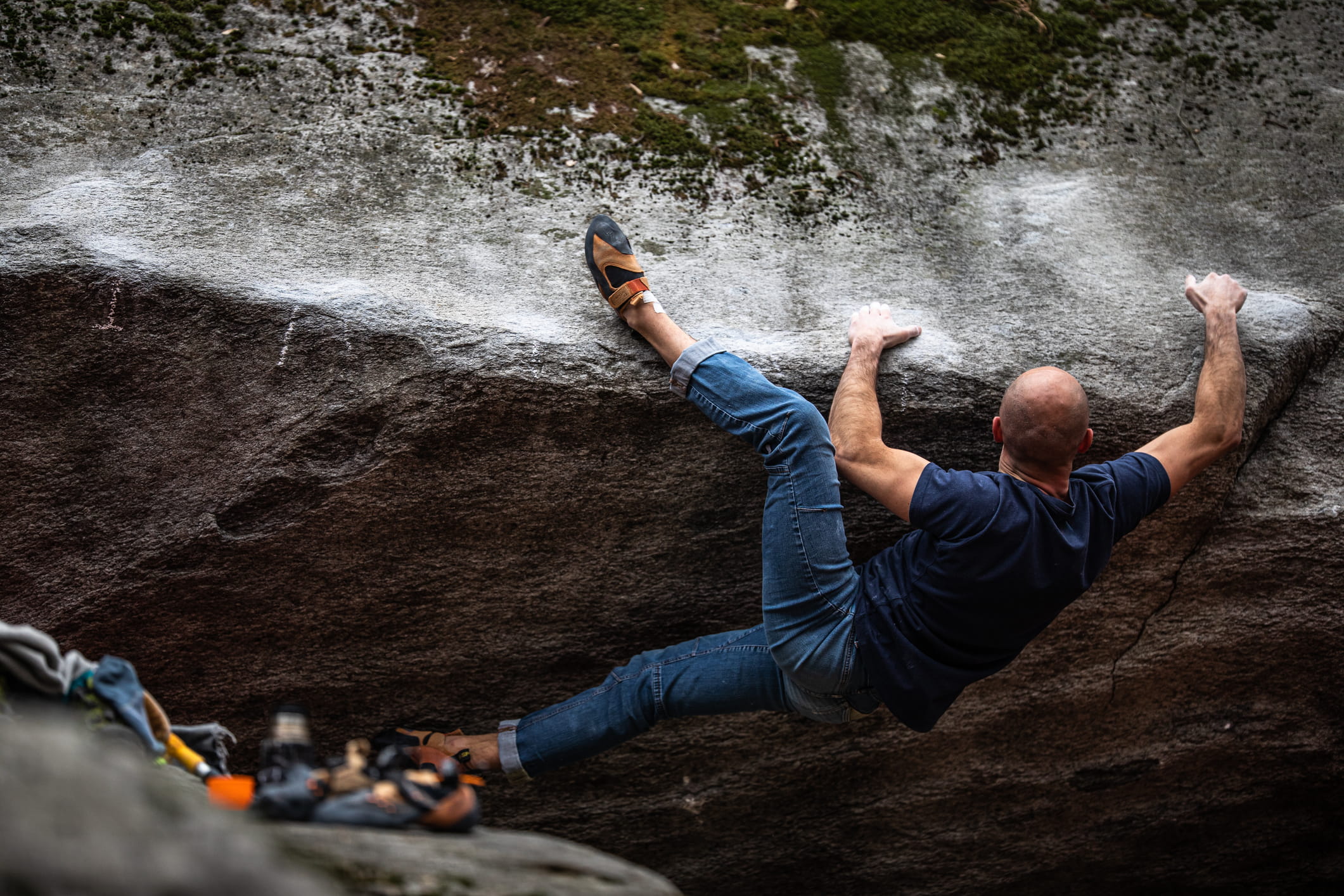
Introduction: The Often Overlooked Climber’s Hamstring Issue
While climbers tend to focus on finger, elbow, and shoulder injuries, lower-limb injuries are becoming increasingly common – especially as modern bouldering and comp-style problems demand a lot of dynamic movement, jumping, and heel hooks.
One of the more frustrating soft-tissue injuries we see in climbers at our clinic in Sheffield and online is distal hamstring pain (away from the torso). The pain from this injury is usually felt in the back or inside of the knee. The distal hamstring tendons attach just below your knee joint. They play a key role in stabilising and controlling the knee during complex movements found in climbing, such as:
- Heel hooks and drop knees - where the knee is bent and the hamstrings contract to stabilise the knee joint.
- High steps - where the hamstring is engaged to pull us over our foot.
- Dynamic moves - where rapid control is needed to stabilise the knee joint on contact.
- Toeing in – where the hamstring pulls the hips close to the wall, and maintaining tension on the foothold.
Overload or poor load tolerance in these tendons and the structures they attach to can cause pain and weakness around the knee, which can prevent you from performing on the wall. When overloaded or irritated, climbers often describe a dull ache or sharp pain when heel hooking, pressing the heel down on a hold, or even just toeing in on a foothold. It doesn’t always stop you from doing some amount of climbing, but this can be one of those injuries that restricts your climbing performance for months if not addressed properly.
Anatomy in Brief: The hamstring and the back of the knee
The hamstrings are a group of three muscles - biceps femoris (long and short head), semitendinosus, and semimembranosus - running from the sit bone on your pelvis down to the bones just below the knee. Importantly, the biceps femoris muscle attaches to the fibula bone on the outside of your shin, and the semimembranosus muscle has an attachment to the medial meniscus.
The hamstring muscles cross two joints (except the short head of the biceps femoris) and perform these main functions:
- Hip extension: The hamstrings help to push our hip forward (think close to the wall) in combination with our glutes.
- Knee flexion: The hamstring muscles pull on the bones of the lower leg to bend the knee (heel hooks, toeing in and high steps).
- Note: This will be the function focused on today and which relates most to the injuries discussed below – We will address proximal hamstring-related injuries in the future.
Common injuries at the back of the knee for climbers
- Distal hamstring tendinopathy – irritation and overload of the hamstring tendon over time (or a big session) causes it to become really grumpy when you’re loading the tendon during the above movements. Tendons need load to improve; rest won’t do much.
- Superior tibiofibular joint sprain – As mentioned above, the biceps femoris tendon attaches to the fibula head. During high loads through the hamstrings, the ligaments that hold the fibula head to the tibia can become sprained or torn. This can often happen when the joint is also under a rotational force, placing the ligaments under greater stress.
- Hamstring muscle strain – This is usually a sudden injury in which the hamstring muscle tears as it’s unable to withstand the load placed on it whilst lengthening. E.g., think of doing a hard heel hook and your hand slips, which places a larger amount of load suddenly into the heel, causing the muscle to tear as it lengthens (while your body is moving downwards).
- Meniscus injury – As mentioned above, the semimembranosus muscle partly attaches to the medial meniscus and can irritate that structure, leading to a sensitive stabilising structure of the knee.
If you’re unsure of which injury you may have and are concerned about what’s going on, you should see a climbing injury specialist to help you figure out the cause of your symptoms.
Causes and Risk Factors of Hamstring Problems in Climbers
Here are the main reasons climbers develop distal hamstring pain.
1. Training Overload
Sudden increases in training volume and sessions heavy on heel hooks, comp-style problems, or high steps, can irritate the tendon and make it intolerant of load.
2. Lacking Strength or Conditioning Training
If your hamstrings aren’t strong enough to tolerate the forces from aggressive heel hooks or drop-knees, the tendon ends up under more strain than it can handle.
3. Insufficient Flexibility/Mobility
Not having enough range of motion in the hamstring can often lead to overload, either by going beyond its available range or by not having enough strength at end-range positions.
4. Previous Hamstring or Knee Injuries
A history of strains or tendon injuries can make the tissue more sensitive to load, increasing the likelihood of recurrence as training load increases. This is more common when you haven’t properly addressed the injury in the past.
Symptoms to Watch For
Common signs that point to distal hamstring involvement include:
- A sharp pain or pulling sensation: behind the knee, especially during heel hooks, high steps, or toeing in on a foothold.
- Pain when straightening the knee under load: When standing from a high foot or a straight leg position to the side.
- Local tenderness around the tendons of the back of the knee or towards the back of the thigh.
- Discomfort when stretching/training: These injuries don’t tend to tolerate stretching. Hamstring flexibility work or lower limb strength training can aggravate the injury.
- Dull ache/sensitivity: Often experienced the day after a high-load training session. This is a very common symptom of tendon pain.
How Physiotherapy Can Help
Distal hamstring injuries can be frustratingly slow to improve without a structured plan. Simply resting often helps symptoms settle down, but as soon as you start heel hooking again, the pain and weakness return. This is usually because the tendon hasn’t been progressively reloaded and reconditioned in the correct position or intensity of load it experiences during climbing.
Here are some basic principles to manage distal hamstring rehab for climbers:
1. Load Management and Protection
- Avoid Aggravating Positions/movements: Early on, reduce or avoid heel hooks, deep drop-knees, or high steps that trigger your symptoms, as they aren’t appropriate for most whilst climbing – we find it more helpful to expose the knee to this kind of stress with controlled exercises.
- Modify Climbing: This can mean selecting climbs that are less likely to place heavy loads on the affected tissue, allowing you to continue climbing around your injury. It also means modifying the duration, intensity, and number of climbs you perform in a session to avoid triggering significant flare-ups.
- Gentle Mobility: This kind of movement focuses on improving and maintaining hamstring mobility during the early stages of the rehab.
2. Managing Pain and Irritation
- Relative Rest: Minimise the amount of high-load lower limb activities that flare up your injury, because this will slow the process down.
- Ice: Can be useful for pain relief in the early stages if you’re unable to tolerate the pain.
- Heat: Tendons prefer warmth, so maintaining warmth helps them feel less sensitive.
- Note: If you’re seeing a large bruise/bleed on the hamstring, avoid putting heat directly on it.
- NSAIDs: We generally avoid anti-inflammatory in the acute phase of an injury but they can be useful if inflammation is an ongoing issue and prevents progression.
3. Strengthening and Tissue Reconditioning
Progressive loading for these injuries is essential. We need to find a tolerable load level and gradually increase it over time so the injury resolves and you can climb without pain or restriction.
Recommended equipment:
- Dumbbells (preferred) or heavy resistance bands
- Furniture sliders/towel
- Bench or step
Intensity: Is often relative to the individual. We often recommend loading at a level you find tolerable, without worsening the pain significantly afterwards or the next day. Some pain when loading can be beneficial, but it’s usually better to start slowly because you can always add more later.
Frequency: You can do this movement daily or every other day if the injury allows. If you’re unsure what will be best, start with fewer sessions and see if your injury can tolerate them before increasing the number.
Exercises for Distal Hamstring Rehab
1. Hamstring Bridge (Double or Single Leg)
Why: This exercise builds your tendon strength.
How:
- Lie on your back with your knees bent and heels on the floor.
- Lift your hips to form a straight line from shoulders to knees.
- Lower hips to the floor, keeping them under control.
- Progress this movement into single-leg versions when you’re ready.
- 3 sets, 8 to 10 reps
2. Slider Leg Curls
Why: This exercise strengthens the hamstrings eccentrically which is key for tendon adaptation.
How:
- Lie on your back with your heels on sliders (for carpet) or towels (for a hard surface).
- Lift your hips to the bridge position, slowly slide the heels away, lower the hips to the floor, then pull the heels back in.
- 3 sets, 6 to 8 reps
3. Arabesque
Why: Helps with mobility and trains the tendon from the hip side whilst building strength and stability throughout the leg.
How:
- Stand on just one leg, and adopt a slight knee bend (~15 degrees)
- Hinge forward at the hip whilst maintaining a straight line from your shoulder to the ankle of the other leg.
- Lower to a point of discomfort, then return to the starting position without putting your foot to the floor, and repeat.
- 3 sets of 6 to 8 reps
4. Step up
Why: Strengthens the entire leg. The higher the step, the more you train the tendon to be ready for high feet on the wall.
How:
- Place your foot on the step or box, rock over, and push up from that leg.
- Slowly reverse the movement without dropping to the floor, i.e., maintain the tension.
- 3 sets of 6 to 8 reps
Load Management Tips for Climbers
- Be Patient: Tendon healing and reconditioning can take 8 to 12 weeks or longer.
- Monitor Your Load: Gradually reintroduce heel hooks or high steps once you can better tolerate daily activities and strengthening.
- Use Pain as Feedback: Mild discomfort during your rehab exercises is fine, but sharp pain or post-exercise flare-ups mean you’ve overdone it. Record your symptoms alongside your climbing/training/rehab load to assess what you’re doing and how to modify it.
- Train around the injury: Don’t forget to continue training other parts of your body, such as your fingers, upper body strength and conditioning, and core strength.
When to Seek Professional Help
If your pain has lasted more than 3 or 4 weeks, worsens with loading, or you notice swelling or bruising around the knee, it’s worth seeing a climbing physiotherapist. A proper assessment can confirm whether it’s hamstring-related or another cause of posterior knee pain. When following a structured plan, most climbers return to climbing within 6 to 12 weeks.
If you’re struggling with pain in the back of your knee/thigh and can’t seem to shift it with some of the above advice, then book in an assessment at the clinic or online, and we can help you get back to climbing at your limit without pain or restriction:
Book an appointment now online: https://whitehouseclinic.connect.tm3app.com/book/sheffield_climbing_clinic
Want more articles like this? https://www.sheffieldclimbingclinic.com/articles
Email us any queries: info@sheffieldclimbingclinic.com
Call us to make a booking: 0114 263 2054
Final Thoughts
Distal hamstring pain might not get as much attention as finger or shoulder injuries, but it can be just as limiting. It can stop you from heel hooking or trusting your lower body in difficult positions. The good news is that with the right mix of protection, progressive loading, and patience, you can rebuild tendon strength and return stronger than before.
Something worth considering is that pain doesn’t mean permanent damage, and gradual, consistent loading is your best friend in tendon recovery. Track your progress, respect the process, and your hamstring (and your climbing) will be much better off for it.
If you have found this article useful and know someone who would benefit from this information, please share it with them!


